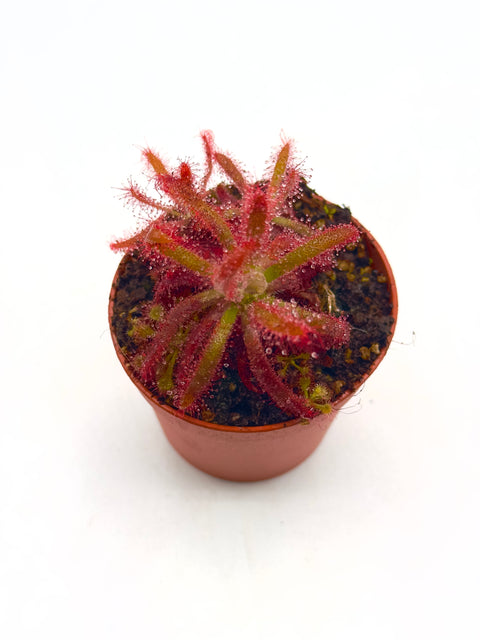
Drosera capensis: the “sticky” carnivorous plant that traps insects slowly
Have you ever seen a plant capture an insect… without moving quickly?
Drosera capensis uses a completely different strategy compared to the Venus flytrap (Dionaea muscipula).
No sudden snaps: here, the trap is slow, elegant, and… inexorable. But how does it really work?
What is Drosera capensis (and why does it catch insects)
Drosera capensis is a carnivorous plant native to South Africa, where it grows in nutrient-poor soil.
To survive, it has developed an effective solution:
👉🏻 capturing and digesting insects to obtain nitrogen and other essential elements.
It is one of the easiest carnivorous plants to grow and is also highly popular among beginners.
How the Drosera capensis trap works
Unlike the Dionaea, the Drosera uses leaves covered in sticky trichomes.
What the trap is made of
• Long, thin leaves
• Trichomes covered in shiny droplets
• Viscous substance similar to dew (it actually acts like glue)
• Bright color to attract prey
Those glittering droplets are not water: they are a deadly trap.
The capture mechanism
1. Attracts prey
The shiny drops look like nectar and reflect light, attracting small insects.
2. The insect gets stuck
As soon as it touches the surface:
• It becomes trapped in the sticky substance
• The more it moves, the more it gets stuck
👉🏻 It is a passive trap, but an extremely effective one.
3. The leaf moves slowly
At this point, something surprising happens:
• The trichomes begin to bend toward the prey
• The leaf may curl up on itself
The movement is slow (taking minutes to hours), but precise.
4. Digestion begins
Once the prey is locked in:
• The plant releases digestive enzymes
• It dissolves the soft parts of the insect
• It absorbs the nutrients
The process can last several days.
Why is the Drosera so effective?
Many people think that a slow trap is less efficient. In reality, it is the opposite.
The Drosera:
• Does not waste energy on rapid movements
• Easily traps small and numerous insects
• Uses a continuous and reliable strategy
👉🏻 It is perfect for environments where prey are frequent but small.
Fun fact: a “hypnotic” trap
The name “Drosera” comes from the Greek *drosos*, which means dew.
But be careful:
those bright droplets are one of the most deceptive illusions in the plant world.
Many insects are attracted precisely because they seem harmless.
In short
• Drosera capensis is a carnivorous plant
• It uses sticky trichomes to capture insects
• The trap is slow but effective
• It digests the prey over several days
• It is also ideal for those just starting with carnivorous plants
Conclusion
Understanding how Drosera capensis works means discovering another extraordinary example of natural adaptation.
It does not need speed to hunt:
its strength lies in patience and precision.
And that is precisely what makes it one of the most fascinating carnivorous plants to observe. 🌿