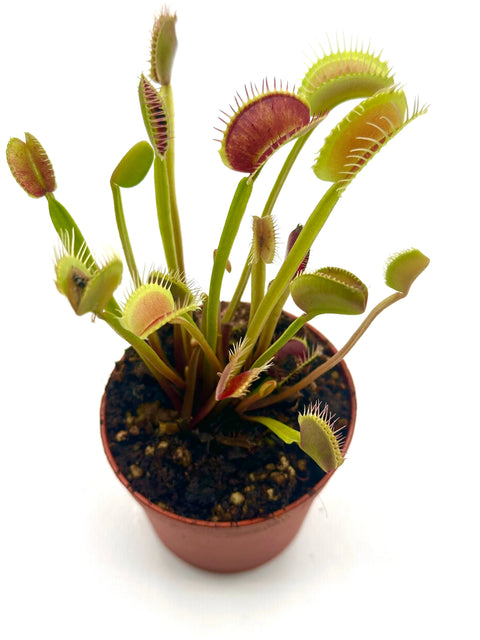
Dionaea muscipula: how the trap of the most famous carnivorous plant really works
Have you ever seen a plant snap shut on an insect in an instant?
The Dionaea muscipula, known as the Venus flytrap, is one of the most surprising plants in nature.
Its capture mechanism is fast, precise, and almost “intelligent.” But how does it really work?
What is the Dionaea muscipula (and why does it catch insects)
The Dionaea muscipula is a carnivorous plant that lives in marshy environments, where the soil is poor in nutrients.
To survive, it has developed a unique strategy:
catching and digesting insects to obtain the substances missing from the soil.
It is precisely this feature that makes it one of the most fascinating and sought-after carnivorous plants.
How the Venus flytrap’s trap works
The trap is a modified leaf, designed to attract and ensnare prey.
How the trap is made
- Two lobes that close rapidly
- Lateral “teeth” (cilia) that prevent escape
- Internal sensitive hairs that trigger the mechanism
- Deep red color to attract insects
The capture mechanism (simply explained)
1. Attracts prey
The plant produces nectar and uses vibrant colors to attract small insects.
2. Waits for the right moment
When the insect touches the internal hairs:
- A single touch is not enough
- Two stimuli in close succession are needed
- This prevents unnecessary closures
3. Snaps shut in less than a second
The trap closes rapidly, trapping the prey.
It is one of the fastest movements in the plant kingdom.
4. Digestion begins
If the insect keeps moving:
- The trap seals completely
- Digestive enzymes are released
- The process takes about 5–10 days
In the end, only the exoskeleton remains.
Why doesn’t the trap close every time?
Many people ask: why doesn’t the Dionaea snap every time?
The answer is simple: energy conservation.
The plant:
- Avoids false alarms (rain, dust)
- Only activates with precise stimuli
- “Decides” when it is worth closing
A surprising behavior for a plant.
Trivia: a plant more “intelligent” than it seems
The Venus flytrap doesn’t react randomly:
it analyzes stimuli and optimizes its energy.
It is precisely this that makes it one of the most fascinating and viral plants.
In short
- It is a carnivorous plant
- It uses leaf-traps to catch insects
- It closes only after precise stimuli
- It digests its prey in about a week
Conclusion
Understanding how the Dionaea muscipula works means discovering one of nature’s most incredible mechanisms.
It is not just a decorative plant:
it is a perfect example of adaptation and evolution.