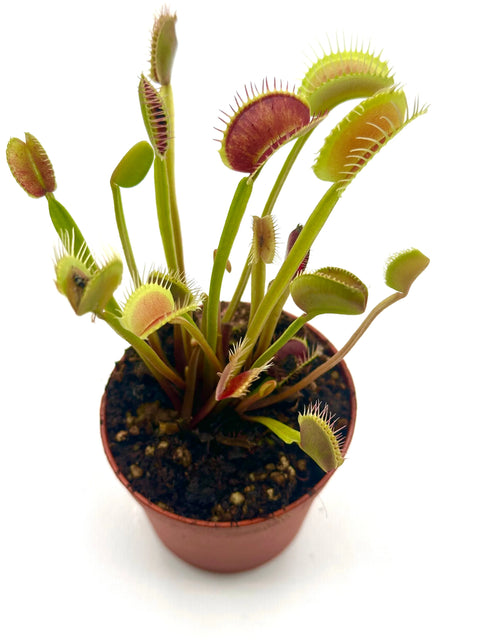
The Dionaea muscipula, commonly known as the Venus flytrap, is one of the most fascinating carnivorous plants in the world. Famous for its rapid-closing mechanism, this species has evolved highly specialized strategies to capture insects and obtain essential nutrients from nitrogen-poor environments.
Native to the subtropical bogs of North and South Carolina in the United States, the Dionaea muscipula lives in acidic, nutrient-poor soils, where carnivory represents a crucial evolutionary adaptation.

How the Dionaea muscipula trap works
The leaves of the Dionaea muscipula are modified into bilobed structures that act as true active traps.
Each lobe features:
-
Trigger hairs: generally three on each side
-
Dentate margins: eyelash-like structures that prevent the prey from escaping
- Digestive glands: responsible for enzymatic secretion

The capture mechanism
The trap only closes when prey touches one or more trigger hairs twice within about 20 seconds. This sophisticated system reduces false alarms caused by rain or debris.
When the stimulation exceeds the threshold:
- An electrical action potential is generated
- Leaf cells rapidly change their internal pressure
- The leaf moves from a convex to a concave state
- The trap closes in about 0.1–0.3 seconds
This movement is one of the fastest in the plant kingdom!
Sealing phase: avoiding energy waste
If the prey continues to move inside the trap, further stimuli induce a tighter seal.
In this way:
- Escape is prevented
- The entry of bacteria or fungi is blocked
- Digestion is optimized
If the captured object is not nutritionally viable, the trap reopens after a few hours or days without initiating full digestion.
Prey digestion: an advanced biochemical process
Once sealed, the Dionaea muscipula secretes digestive enzymes, including:
Proteases
Phosphatases
Chitinases
Nucleases
These enzymes break down:
Proteins
Exoskeletons
Nucleic acids
Organic phosphorus

Nutrient absorption
The plant primarily absorbs:
Nitrogen
Phosphorus
Potassium
Micronutrients
Digestion generally lasts from 5 to 12 days, depending on the size of the prey and environmental conditions.
What remains after digestion?
At the end of the process, the trap reopens, revealing the insect's empty exoskeleton.
Each individual trap can function effectively only a few times (generally 3–5 captures) before it deteriorates.

Why is the Dionaea muscipula a carnivorous plant?
Carnivory does not serve as a primary source of energy (which is still derived from photosynthesis), but rather as mineral supplementation.
Evolutionary advantages:
Survival in oligotrophic soils
Increased nitrogen availability
Improved growth
Greater reproductive capacity

Common misconceptions about the Venus flytrap
-
Feeding the plant manually too often
Excessive stimulation weakens the traps. -
Giving it meat or human food
The Dionaea is adapted exclusively to small, live, or freshly killed prey. -
Touching the traps for fun
Every closure consumes precious energy.
Scientific curiosities
Charles Darwin called the Dionaea “one of the most wonderful plants in the world.”
Conclusion
The Dionaea muscipula represents an extraordinary example of evolutionary adaptation, combining plant mechanics, biochemistry, and environmental sensitivity in a single organism.
Understanding how it captures and digests its prey not only increases appreciation for this iconic plant, but also helps in cultivating it correctly while respecting its natural physiology.
If grown in the right conditions, the Venus flytrap continues to demonstrate why it is one of the most extraordinary carnivorous species in global botany.