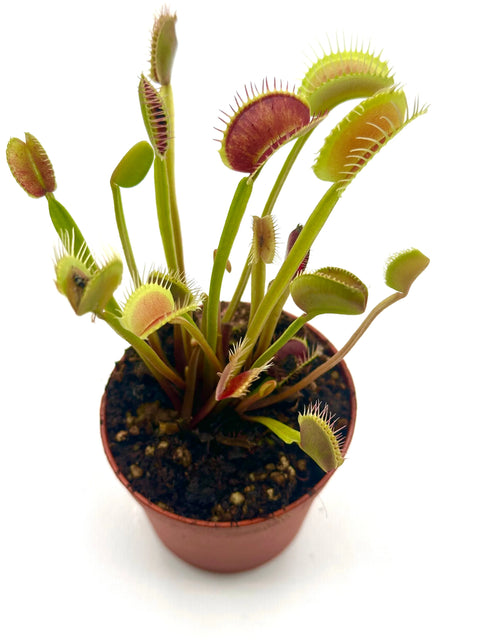
Dionaea muscipula: characteristics and natural habitat
The Dionaea muscipula, commonly known as the Venus flytrap, is one of the most fascinating and recognizable carnivorous plants in the world. It belongs to the Droseraceae family and is a species endemic to the coastal plains of North and South Carolina in the United States.
In its natural habitat, it grows in extremely nutrient-poor, acidic, and constantly damp soil. To compensate for the lack of nitrogen and phosphorus in the substrate, it has developed the ability to capture small insects using its famous snap traps.
Contrary to popular belief, the Dionaea is not a tropical plant, but a temperate species that requires a winter rest period to remain healthy in the long term.

How to grow the Dionaea muscipula properly
Cultivating the Dionaea muscipula requires adhering to certain fundamental conditions that reproduce its natural environment as closely as possible.
Exposure: plenty of light but not direct sun
Light is the most important factor for the plant's health.
To obtain robust traps, intense coloration, and vigorous growth, the Dionaea must receive at least:
- 4-6 hours of strong light per day;
- preferably south or south-east exposure, but avoid direct sun during the hottest hours;
- intense natural light throughout the year.
A lack of light causes elongated leaves,
- small traps and loss of the typical internal reddish coloration. - extremely wide leaves and serrated margins
What water to use for the Venus flytrap
One of the most common mistakes concerns watering.
The Dionaea is extremely sensitive to the mineral salts present in tap water.
The accumulation of calcium, magnesium, and other minerals can progressively damage the roots and eventually cause the plant to die.
The only recommended water types are:
- clean rainwater;
- distilled water;
- reverse osmosis water with a very low
total dissolved solids (TDS) level.
The ideal conductivity should be less than 50 ppm (parts per million).
Correct watering method
The best technique is the so-called tray method.
- Place the pot in a tray.
- Maintain 1-2 cm of water at all times during the growing season.
- Reduce humidity during the winter rest period without letting the substrate dry out completely.
This system ensures a constant supply of water to the roots without causing water stress.
The ideal substrate for Dionaea muscipula
Universal potting soil must be avoided at all costs!
The Venus flytrap needs a nutrient-poor and highly acidic substrate.
The mixture most used by experts consists of:
- 50% unfertilized acidic blonde peat moss;
- 50% perlite.
Alternatively, you can use:
- blonde peat moss and washed silica quartz sand;
- live or rehydrated sphagnum moss for advanced cultivation.
The ideal pH of the substrate is generally between 3.5 and 5.5.
Do I need to feed the Dionaea?
In most cases, no.
If grown outdoors, the plant captures all the necessary prey on its own.
Forcing feeding can cause problems:
- unnecessary closing of the traps;
- excessive energy consumption;
- rot caused by prey that is too large.
You must never administer:
- meat;
- ham;
- cheese;
- pet food;
- fertilizers in the soil.
The roots of the Dionaea are not adapted to handle high concentrations of nutrients.
Winter rest: an essential phase
One of the most overlooked aspects in the cultivation of the Dionaea muscipula is the dormancy period.
In nature, the plant faces cold winters and drastically slows down its vegetative activity.
During the rest period:
- growth stops almost completely; - leaves become lower and more compact;
- some traps may turn black.
Dormancy generally lasts from November to February.
The ideal temperatures are between 0 °C and 10 °C.
Without this rest period, the plant tends to weaken progressively and may die after a few years.
Repotting the Dionaea muscipula
Repotting is recommended every 1-2 years.
The best times are:
- before winter in the autumn;
- early spring.
During repotting, it is possible to:
- replace degraded substrate;
- divide any developed rhizomes;
- check the condition of the root system.
It is preferable to use pots that are at least 8-12 cm deep to encourage root development.

Common problems and solutions
Black traps
It is normal for older traps to turn black and die.
It becomes worrying, however, when the entire plant shows rapid deterioration, often caused by:
- tap water;
- poor lighting;
- too much direct sun/excessive heat;
- red spider mites.
Traps that do not close
This may be due to:
- old traps;
- transport stress;
- insufficient light exposure.
Each trap can close only a limited number of times before it wears out.
Slow growth
The most frequent causes are:
- lack of light;
- absence of dormancy;
- inadequate substrate;
- water with too many mineral salts

Frequently asked questions about growing Dionaea muscipula
Can the Dionaea live indoors?
It can survive, but it generally grows better outdoors in a very bright environment. Indoors, it often suffers if it is made to skip its winter rest.
How long does a Venus flytrap live?
With proper cultivation, it can live for over 20 years, continuously producing new rosettes from the rhizome.
Is the Dionaea dangerous to people?
No. The traps are designed to capture small insects and do not pose any risk to humans or pets.
Can I use fertilizers?
No. Traditional fertilizers can severely damage the roots and compromise the plant's health.
Conclusion
Growing Dionaea muscipula is much simpler than it seems when three fundamental principles are followed: pure water, abundant light, and winter rest.
By reproducing the conditions of the peat bogs from which it comes, this extraordinary carnivorous plant can grow vigorously for many years, providing one of the most fascinating spectacles in the plant kingdom: the active capture of its prey.